Woodlands South’s Next Chapter: New Homes, Better Connectivity and Everyday Amenities
Blogs30 Oct 20265 min read

Woodlands South is an emerging residential neighbourhood. For some, however, the area is familiar: it holds memories for former students of Innova Junior College, which later merged with Yishun Junior College to form Yishun Innova Junior College, as well as for students and alumni of Singapore Sports School, which is slated to relocate to the Kallang Alive precinct.
With the schools’ presence forming a significant part of the area’s identity, their eventual departure raises a broader question: what will shape Woodlands South in the years ahead?
One part of the answer is the growth of housing across the neighbourhood. BTO flats, private condominiums and executive condominiums are adding to its residential base, as Woodlands South develops into a more established housing estate. As more homes are completed and occupied, the neighbourhood’s character will evolve through both its built environment, and the facilities residents rely on in their daily lives.
A new look for Woodlands South
Before the Thomson-East Coast Line opened, Woodlands South had fewer direct rail connections, which meant residents relied more heavily on buses and road transport to reach the wider MRT network.

The opening of Woodlands South station in January 2020 improved this access, connecting the neighbourhood to the TEL and the wider MRT network. With the TEL, , Woodlands Regional Centre is less then 5-minutes away, while key central commercial districts like Orchard Road and the CBD are 30- and 40- minutes away respectively.
The future North-South Corridor is expected to add further options by linking the northern region with the city and providing dedicated space for buses, cycling and walking as it is completed, providing alternatives to the arduous and slow commute via the Central Expressway that Northsiders have grumbled about for decades.
Together, these transport improvements are strengthening Woodlands South’s accessibility and may broaden its appeal to residents seeking a well-connected home in the North.
Woodlands South’s Renewal as a Residential District
Woodlands South developed as Woodlands expanded beyond its original town centre. As the established heartland filled with homes, amenities, commercial spaces and industrial facilities, residential development extended south towards the area surrounding the Woodlands South MRT station, near the Seletar Expressway (SLE).
Public housing formed an early part of this expansion. Many HDB flats in the area date from around 1997 to 1999, and public housing remains a significant part of the neighbourhood’s residential profile. Over time, the area has also gained private housing, schools and a mix of commercial and industrial uses.
More recently, new housing and transport improvements have added to the area’s development. 3,016 HDB flats are either under five years old or under construction, contributing to a growing residential base. The Thomson-East Coast Line, including Woodlands South station, began service in January 2020 and has strengthened the neighbourhood’s rail connectivity. Together, these changes are supporting Woodlands South’s evolution as a residential district.
Table 1: Stock of HDB flats in Woodlands South
| Flat age range | No. of units |
| Under 5 years / under construction | 3,016 |
| 5-10 years | 888 |
| 25-30 years | 7,675 |
Source: HDB as at 27 Oct 2026, ERA Research and Market Intelligence
The area also has an established stock of older HDB flats, including 7,675 units aged between 25 and 30 years. This cohort represents a potential pool of future upgraders, while newer public housing brings additional households into the neighbourhood. Combined with nearby schools and developing amenities, these factors may appeal to owner-occupiers considering private homes or executive condominiums. They provide a foundation for demand, although the performance of individual developments will also depend on pricing, design and buyers’ needs.
An Expanding Neighbourhood Anchored Around GLS Developments
Woodlands South’s growing supply of HDB flats provides a potential pool of future upgraders for private residential and executive condominium developments. This demand base is supported by GLS sites released in recent years, which have attracted bids from developers and added new private housing to the area.
Table 2: GLS sites in Woodlands South
| GLS Site | No. of Bidders | GLS Programme | Project Name | Take-up Rate |
| Champions Way | 6 | 1H 2023 | Norwood Grand | 95% |
| Woodlands Dr 17 (EC) | 5 | 1H 2025 | Wynwood Grand | - |
| Woodlands Dr 17 (EC) #2 | 3 | 2H 2025 | Clovelle at Woodlands | - |
Source: URA, ERA Research and Market Intelligence
HDB resale activity in Woodlands has varied over the period shown in Chart 1, while average resale prices have generally increased. From $342 psf in 2017 to $545 psf in 3Q 2026, the average price rose at a compounded annual growth rate (CAGR) of about 5.3%.
Chart 1: HDB Resale Transactions vs Average Resale Price ($psf) in Woodlands South
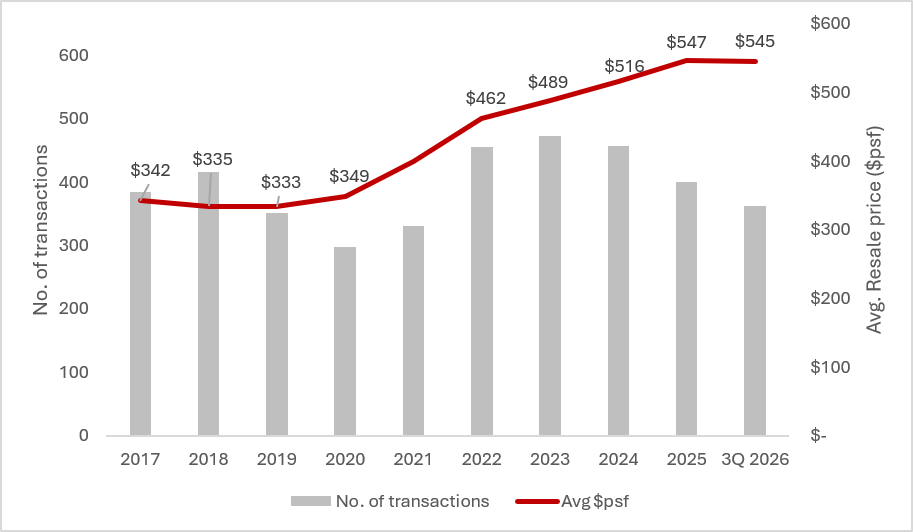
The age profile of the HDB stock also provides context for how the resale market may develop. Flats aged 25 to 30 years form an established segment, while newer flats, including those under five years old or still under construction will add to the pool of homes over time.
As owners of newer flats complete their Minimum Occupation Period (MOP), some flats may enter the resale market, potentially increasing transaction activity and spurring greater price growth in the area.
For private residential and EC developments, Woodlands South’s established HDB base may provide a pool of prospective upgraders, while newer homes continue to expand the neighbourhood’s housing options. The area’s appeal to owner-occupiers will also depend on factors such as pricing, location, amenities and individual housing needs.
Drawing on Woodlands’ Wider Ecosystem
As Woodlands South develops its own residential character, residents can also draw on the wider range of facilities and services across Woodlands. The town is planned as the regional centre for the North, with a mix of retail, commercial, community and employment uses. Its education network spans primary and secondary schools, as well as tertiary education at Republic Polytechnic.

Healthcare is available close to the neighbourhood at Woodlands Hospital, formerly known as Woodlands Health Campus. The campus is connected to Woodlands South MRT station, bringing major healthcare services within easy reach of residents.
Cross-border connectivity is also set to improve with the Johor Bahru–Singapore RTS Link, which will connect Woodlands North to Bukit Chagar in Johor Bahru. Passenger service is currently targeted for February 2027. From Woodlands South, residents will be able to connect to the RTS Link via the Thomson-East Coast Line, extending the neighbourhood’s access to destinations beyond Singapore.
Together, these wider resources complement Woodlands South’s growing local amenities and housing base. They give residents access to services across the town while the neighbourhood continues to mature.